What is a smart gym (and why 2026 is its year)
Published on February 4, 2026 · 8 min read
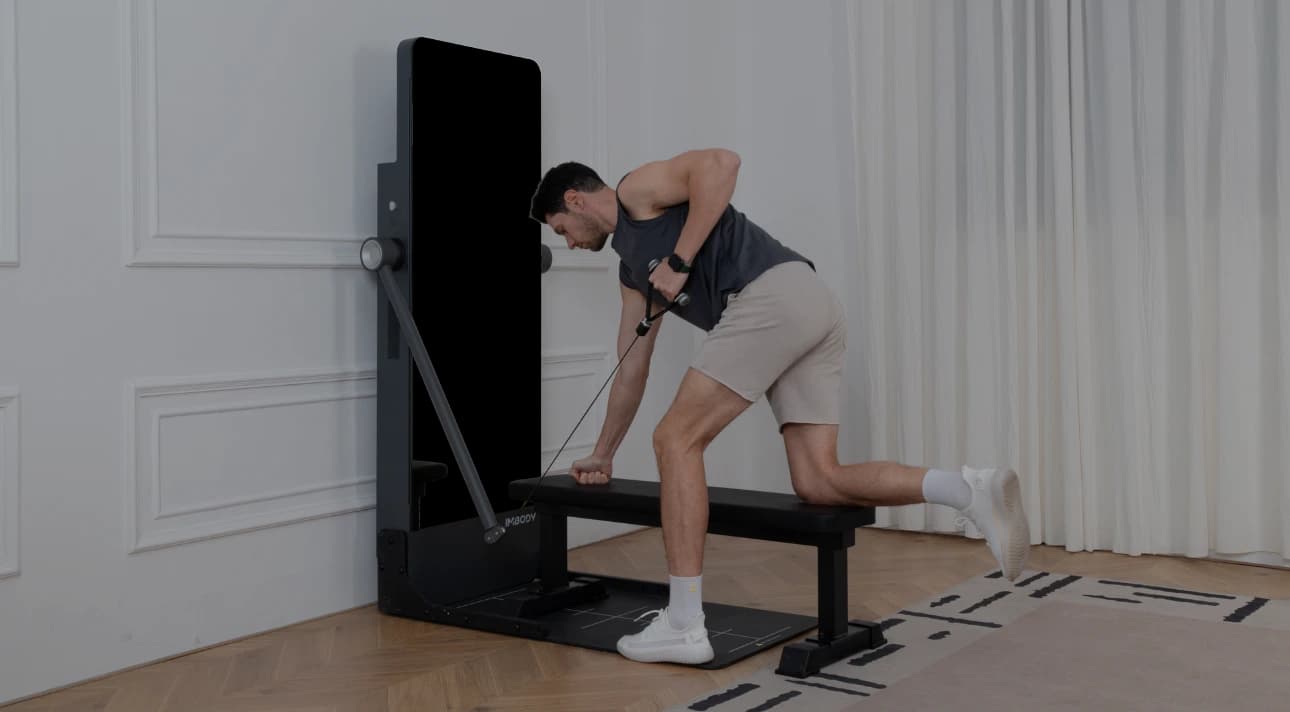
If you wanted to train strength seriously in 2015, you had two options: pay for a gym forever, or fill a room with plates, benches and a rack. In 2026 there's a third: the smart gym, a category almost nobody knows yet in Spain and that is about to do to fitness what the air fryer did to cooking.
What exactly is a smart gym
A smart gym (or smart home gym) is a compact machine that generates resistance with digitally controlled electric motors instead of plates and weight stacks. The one we distribute, the Prodigy IMBODY Power S Pro, has the most radical format in the category: a full-length mirror with a 43" touchscreen hidden behind it, two adjustable cable arms, and a 0.1 m² floor footprint.
The difference from a classic cable machine isn't aesthetic — it's physical:
- The resistance is digital. Two 750 W brushless motors generate up to 120 kg (60 per arm, independently adjustable in 0.5 kg steps). No plates to buy, move or hear clanging.
- The resistance is programmable. The same cable can behave like free weight, like a resistance band, hold a constant speed, or load you more on the eccentric phase. These are the 5 training modes: standard, constant speed, elastic, eccentric and burnout.
- There's an AI watching your set. Booster Mode works like a spotter: when it detects muscular fatigue, it lowers the load automatically so you finish the rep safely. Training alone stops being a risk.
"Does this really replace a gym?"
That's the right question. Short answer: for strength training and rowing cardio, yes — the manufacturer sums it up as the equivalent of 260 machines. The long answer depends on what you do at your gym:
- Cable and barbell strength: covered. Presses, rows, pulldowns, squats, deadlifts, curls, triceps… the built-in catalogue holds nearly 1,000 exercises guided by virtual coaches.
- Guided classes: covered, with over 350 video classes from 10 to 120 minutes, by goal and level.
- Cardio: the machine turns into a rowing machine with the included bench, complete with interactive on-screen games.
- Bench press with a 180 kg Olympic barbell, or a pool: no. Be honest about your use case.
One nuance almost nobody mentions: 120 kg of digital resistance doesn't feel like 120 kg of iron. With no inertia, the muscle works under constant tension throughout the whole range of motion — for hypertrophy and for protecting joints that's an advantage, not a limitation.
What really changes: the fees
Here's the economic argument that explains why the category is taking off. An average gym in Spain costs between €30 and €80 a month, forever. The savings calculator on our site does the exact maths with your own fee, but the quick version: at €50/month, €6,000 every ten years — and only the person paying the fee gets to train.
A smart gym is a one-off purchase (€4,899 for the Power S Pro, payable in instalments) and the whole household trains: you, your partner, your teenage kids. No mandatory subscription: the nearly 1,000 exercises and 350+ classes are built into the machine, and the companion app is optional and free. That's the big difference against US competitors like Tonal or Peloton, which inflate the price with compulsory monthly fees.
The other change: where it lives
Classic cable machines demand a room. A mirror-format smart gym is designed for the living room or the bedroom: switched off it's a full-length mirror (useful in itself), switched on it's the 43" screen. Its 0.1 m² footprint is literally less than a chair takes up.
For the profile that writes to us every week — a 30-to-45 couple with a well-kept flat who doesn't want "a gym machine" in the middle of the house — this is the decisive argument, more than the kilos.
Who it makes sense for (and who it doesn't)
It makes sense if: you train, or want to train, strength 2–5 days a week and the commute to the gym is what stops you; two of you pay fees at home; you're rehabilitating or you're 50+ and want controlled, progressive load; or you already know you could move the iron at your gym just as well in your living room.
It doesn't make sense if: you compete in powerlifting with maximal loads well above 120 kg, or if what takes you to the gym is the social side.
How to try it without buying it
The scepticism is fair: it's a new category and a four-figure purchase. That's why we're the official distributor in Spain with a showroom, at-home or video-call demo, delivery in 1–2 days, a 30-day return window and local support — the real difference between buying from a person with a face and a name, or from a box on a marketplace.
If you want the concrete numbers against the best-known alternative, see our full comparison against the Speediance Gym Monster 2. And if you'd rather see it in person: book your demo — no strings attached.