Strength test: measure your 1RM, train with data
What a strength test is, how to estimate your 1RM with the Epley and Brzycki formulas, the training zones that come out of it, and how the Prodigy IMBODY mirror automates it.
The basics
What the 1RM is (and why it matters)
The classic strength test measures your one-repetition maximum, or 1RM: the heaviest weight you can lift once with proper form in a given exercise. It is the reference every serious strength programme is built on.
Knowing your 1RM turns training by feel into training with data: each session's loads are programmed as a percentage of that maximum, and its evolution is the objective measure of your progress.
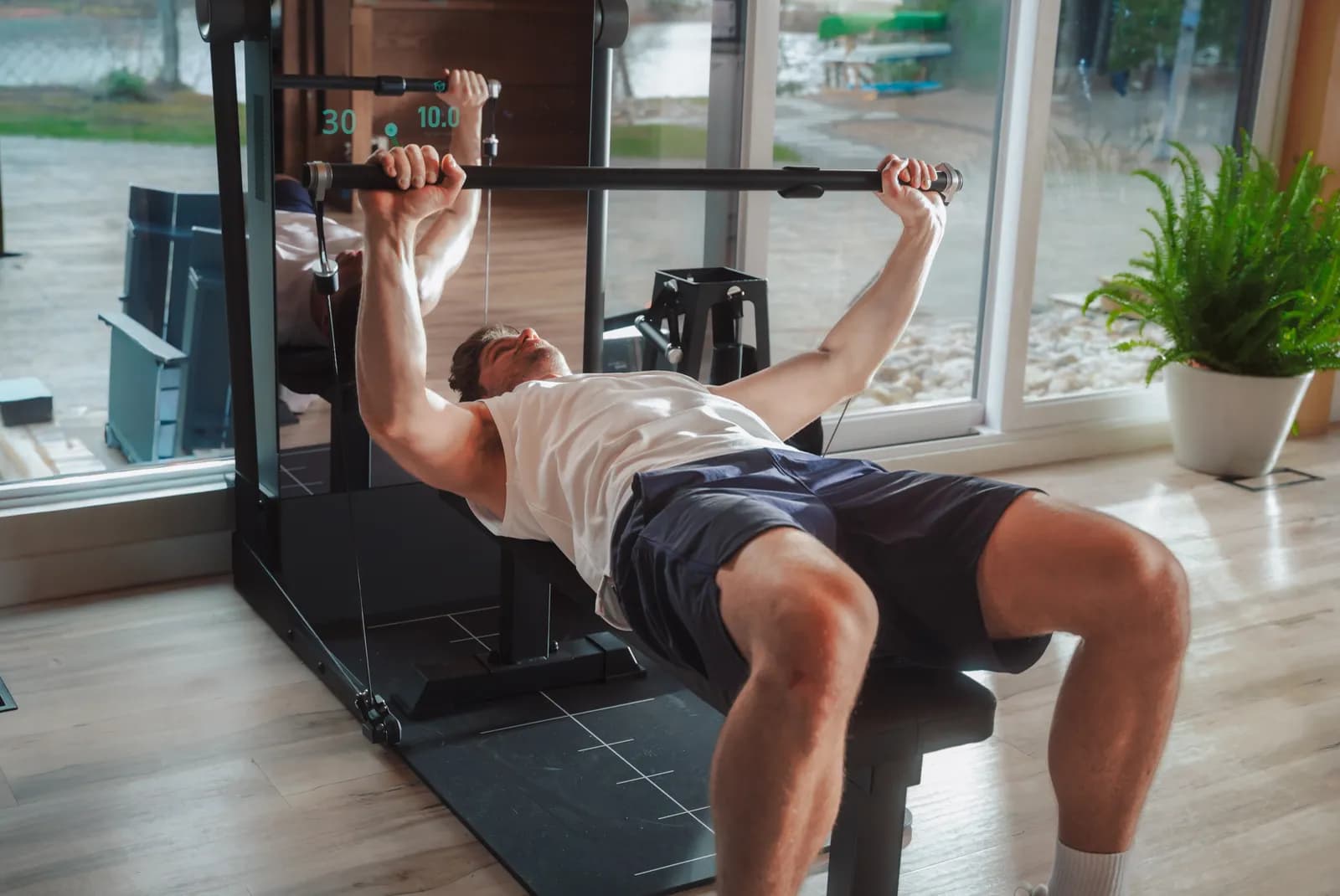
Two ways to measure it
You can reach your 1RM by actually lifting it, or estimate it from a submaximal effort. For most people, the second is the right call.
Direct test
You work up in progressively heavier sets until a true maximum.
Very taxing on the nervous system, with injury risk if form breaks down.
Best left to experienced lifters, ideally with a spotter.
Estimated (submaximal) test
Pick a challenging weight and do as many clean reps as you can.
A formula converts weight × reps into your estimated 1RM.
Safe, repeatable and accurate enough to programme your training.
The maths
The Epley and Brzycki formulas
These are the two most widely used estimation formulas. Both give very similar, reliable results when the test is done between 2 and 10 reps; beyond 10, muscular endurance outweighs strength and the estimate loses accuracy.
Epley
1RM = weight × (1 + 0.033 × reps)
Brzycki
1RM = weight ÷ (1.0278 − 0.0278 × reps)
Example: if you move 60 kg for 8 reps, your estimated 1RM is around 76 kg with either formula.
What you do with the number: training zones
Each goal is trained in a band of intensity relative to your 1RM:
85–100%
Max strength
Sets of 1 to 5 reps with long rests.
67–85%
Hypertrophy
Sets of 6 to 12 reps: the classic muscle-building range.
< 67%
Muscular endurance
More than 12 reps with short rests.
On the Power S Pro
How the mirror automates it
In a traditional gym, a strength test takes a spotter, plates to swap and a spreadsheet. The Power S Pro builds it into the machine: when you create your profile you complete the initial Smart Body Assessment and the system places you at your real level.
From there, Smart Force Assistance recommends the resistance for each exercise and adjusts it with 0.5 kg precision, and every rep is logged: your progress measures itself, session after session.
Initial assessment — A guided questionnaire and evaluation on first login to set your starting point.
Recommended load — The system suggests the resistance for each exercise; you fine-tune it on the fly from the screen or the dials.
Measured progress — Load and rep history per exercise: your real strength, in data, with nothing to write down.
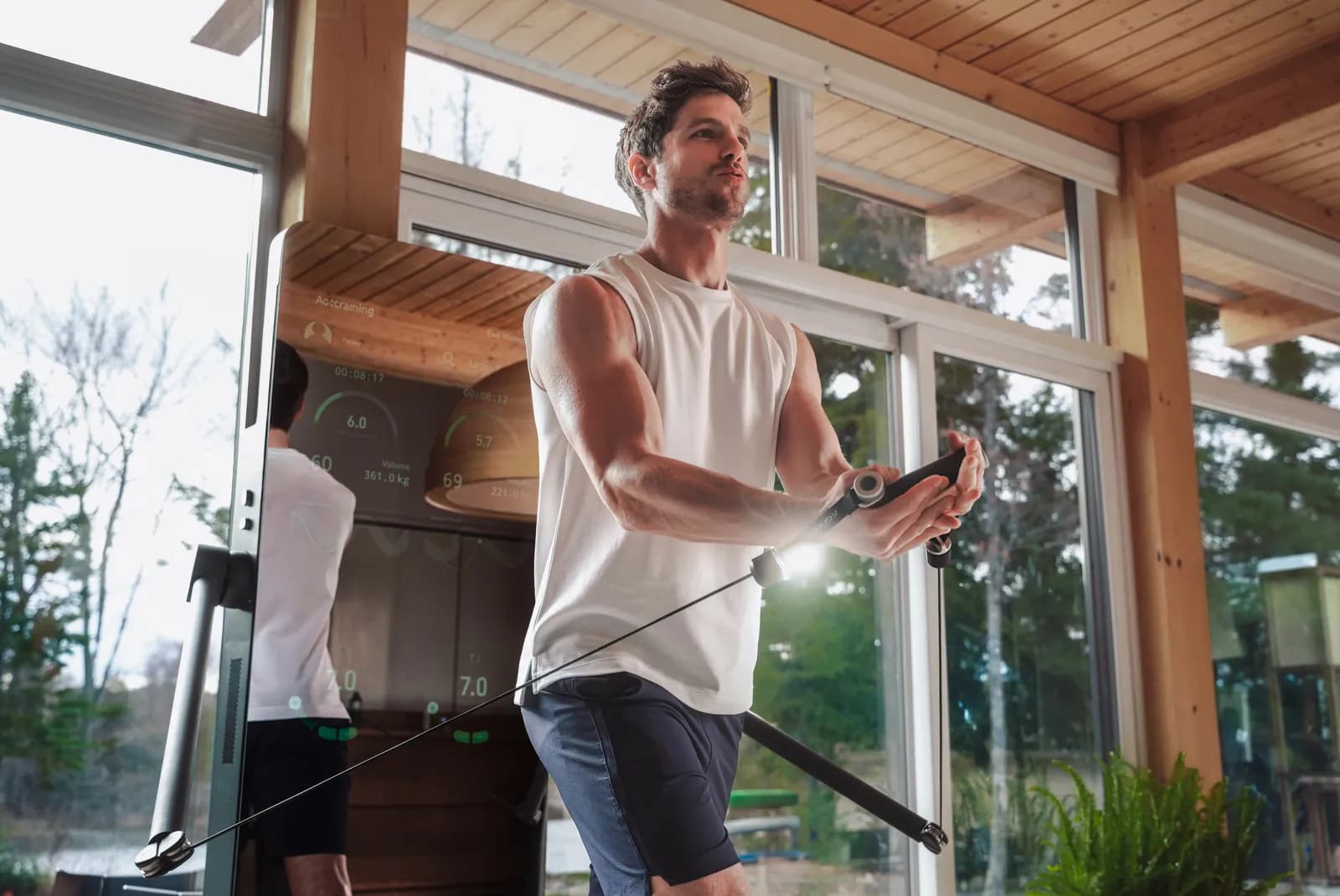
Strength assessment
The IMBODY's 8 tests, muscle group by muscle group
The Power S Pro has a built-in strength assessment made up of eight tests: one per muscle group. In each one you move the reference load the machine itself sets as fast as you can, and that is what gives you your strength level for that group.
The eight results are plotted together on a single chart, so at a glance you see where you are strong and where you have fallen behind. That is what turns a generic plan into a targeted one: from those levels, the machine proposes training matched to your real starting point.
One test per muscle group
- Chest
- Shoulders
- Back
- Core
- Legs
- Hips
- Biceps
- Triceps
Every assessment is stored in the user's account, so each new round is compared with the previous one without you writing anything down.
We recommend running all eight tests when you start the programme and repeating them every quarter.
If you train clients, it is the quickest way to back up with numbers what has changed since the first session.
Before you take a strength test
Warm up properly: progressive ramp-up sets before any heavy effort.
Form rules: a 1RM with broken form isn't your 1RM, it's an injury waiting to happen.
Don't attempt a true max without experience and a spotter.
Retest every 8–12 weeks: that's how often re-evaluating actually makes sense.
Train with data from your first session
The Power S Pro assesses you, recommends the load and logs every rep for you.